
Elephants are the biggest animals that live on land, but size is the least surprising thing about them. Their noses work like hands, their feet seem to listen, and their memory is so famous that it became a saying.

Elephants are the biggest animals that live on land.
There are three kinds of elephants: the African savanna elephant, the African forest elephant and the Asian elephant. Here's what makes all of them remarkable.
A nose that works like a hand
An elephant's trunk is its nose and upper lip joined into one long, flexible tube. It has no bones at all. Instead, it's packed with muscles, about 40,000 of them according to National Geographic.
All those muscles make the trunk strong and precise at the same time. An elephant can use it to pluck a single blade of grass or to carry a heavy log. African elephants have two finger-like tips at the end of the trunk, while Asian elephants have one.
The trunk is also a hose and a snorkel. Elephants don't drink through it like a straw; they suck water up into it, then squirt it into their mouths or over their backs. When they swim, they can hold the trunk above the surface and keep breathing.
The super-sniffer of the savanna

Dogs can smell things thousands of times better than people can.
Dogs are famous for their noses, and for good reason. But in 2014, researchers in Japan who counted smell-receptor genes found that African elephants have about 2,000 of them. That's more than twice as many as dogs and about five times as many as humans, the highest count among the mammals they compared.
Scientists think this keen sense of smell helps elephants find food and water and keep track of who's around.
Feet that listen
Elephants talk to each other with deep rumbles, many of them too low for human ears to hear. Those sounds travel through the air, but they also send vibrations through the ground.
Researchers working with elephants in Namibia found that the animals reacted to alarm calls played back only as vibrations in the ground. Scientists think elephants pick up these signals through sensitive nerve endings in their feet and trunks, and perhaps through the bones of their legs. Elephants have been seen leaning forward or lifting a foot, as if listening carefully.
Their feet are clever in another way, too. Elephants walk on tiptoe, with a thick cushion of fat under the heel that spreads their huge weight and keeps their steps surprisingly quiet.
Does an elephant really never forget?
"An elephant never forgets" is an exaggeration, but it's based on something real. Elephants have the largest brain of any land animal, weighing around 5 kilograms.
Elephant families are led by an older female called the matriarch. Scientists in Kenya found that families with older matriarchs were better at telling the calls of familiar elephants from those of strangers. A long memory helps the whole family know whom to trust.
A few more quick facts:
- An elephant pregnancy lasts about 22 months, the longest of any land mammal.
- Some elephants have recognized themselves in a mirror, something only a few animals do.
- Big ears help elephants cool down: flapping them cools the blood flowing through.
- The elephant is the heaviest animal on land, but its savanna neighbor, the giraffe, is the tallest.
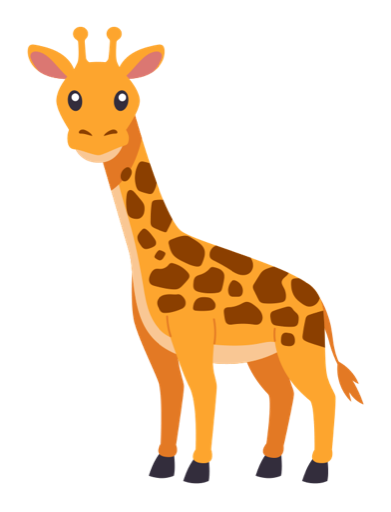
A giraffe's long neck has seven bones, the same number as yours.
In Spinbo, the elephant lives on the Animals wheel in the Wild Side world, where leaves drift across the screen and your buddy calls out, "Hear who's out there!" Each card gives you the animal's name and one clear fact, read aloud in your language and in a second one you pick.
Your next spin might bring a dog, a panda or a giraffe, and every one of them has a surprise of its own.