
Giraffes have long necks mainly so they can reach leaves high in the trees, where few other plant-eaters can compete with them. Many scientists think long necks also help males win fights, because they swing them like hammers. The neck probably evolved for more than one reason, and researchers still debate which mattered most.
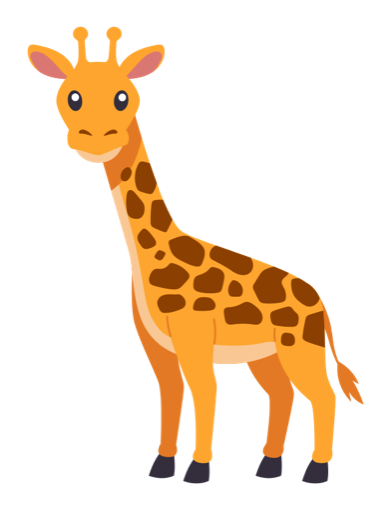
A giraffe's long neck has seven bones, the same number as yours.
Giraffes are the tallest animals on land. Adult males can stand around 5.5 meters (18 feet) tall, and the neck alone can measure about 1.8 meters (6 feet), roughly the height of a tall adult.
Why do giraffes need to reach so high?
On the African savanna, plenty of animals eat leaves, from small antelopes to elephants. A giraffe can browse on branches several meters up, a kind of private top shelf. When food runs short in the dry season, that extra reach may make a real difference.
Acacia leaves are a favorite. Acacias defend themselves with long thorns, but giraffes come prepared: a tongue about 45 centimeters (18 inches) long and nimble lips that work around the thorns, according to the San Diego Zoo. The tongue is dark, almost blue-black, and scientists think the color may protect it from sunburn during long days of eating.

Elephants are the biggest animals that live on land.
Elephants compete for some of the same food, but they solve the height problem differently: they can push a whole tree over.
There's a twist, though. Some field studies have found that giraffes often feed at shoulder height or lower instead of stretching to the top. That's one reason scientists went looking for another explanation.
Do giraffes use their necks to fight?
Yes. Male giraffes fight by swinging their necks and slamming their heads into each other, a behavior called necking. The heavy skull, topped with bony, skin-covered knobs called ossicones, works like a club. As National Geographic notes, most contests end when one male gives up and walks away, but serious blows can knock a rival off his feet.
In 1996, two biologists proposed the "necks for sex" idea: males with longer, heavier necks win more fights, father more calves and pass those necks on. Later studies found mixed evidence, and many scientists now think feeding and fighting may both have played a part.
Did giraffes stretch their necks to make them longer?
No. In the early 1800s, the French naturalist Jean-Baptiste Lamarck suggested that giraffes stretched to reach leaves and passed their slightly longer necks on to their young. That's not how inheritance works. Charles Darwin's idea of natural selection explains it better: giraffes that happened to be born with slightly longer necks were more likely to survive and have calves, and over millions of years necks grew longer. The giraffe's closest living relative, the okapi of the Congo rainforest, has a much shorter neck.
How many bones are in a giraffe's neck?
Seven, exactly the same number as in your neck and in almost every other mammal. The difference is size: each giraffe neck vertebra can be more than 25 centimeters (10 inches) long.
How does blood get all the way up to the brain?
Pumping blood two meters uphill takes a powerful heart. A giraffe's heart weighs about 11 kilograms (25 pounds), and its blood pressure is roughly twice as high as ours. When a giraffe lowers its head to drink, valves in the big neck veins help stop blood from flooding back into the head. Tight, thick skin on the legs works like a compression stocking, keeping blood from pooling in the feet.
Drinking is a giraffe's most awkward moment: it has to splay its front legs wide or bend its knees to reach the water. That's when it is most exposed to lions.
A lion's roar can be heard up to 8 kilometers away.
Lions are the main predators of adult giraffes, but a giraffe can fight back with a kick powerful enough to seriously injure, or even kill, a lion.
Quick giraffe facts
- A newborn calf drops more than 1.5 meters (5 feet) to the ground at birth and can stand within about half an hour.
- Both males and females have ossicones.
- No two giraffes have exactly the same coat pattern.
- Over short distances, giraffes can run at about 56 kilometers per hour (35 mph).
In Spinbo, the giraffe lives on the Animals wheel in the Wild Side world, alongside the elephant, the panda and the dog, while the lion prowls the Wild Animals wheel. Spin, and when the giraffe comes up you'll hear its name and its seven-bones fact, read aloud in your language and then in a second language you choose.
Next time you see a giraffe, look at that neck and remember: seven bones, a giant heart, and a story scientists are still writing.